Egg custard is one of those desserts that proves that with three humble ingredients and a reasonably cooperative oven, you can produce something quite respectable. The principle is simple: a mixture of beaten eggs, sugar, and milk is cooked gently until it reaches a set, smooth, and slightly wobbly texture.
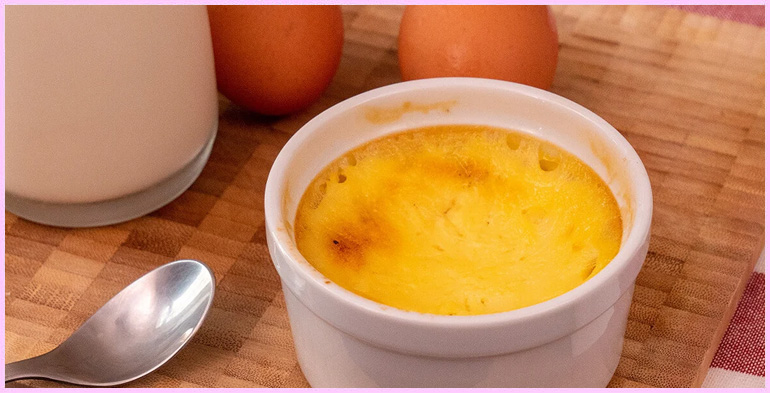
Historically, this type of dessert has existed in Europe for a very long time. As early as the Middle Ages, we find preparations combining milk and cooked eggs. It's understandable; when you have chickens and a cow, you're bound to invent something between a failed omelet and a custard dessert sooner or later. Each country has developed its own variation: crème caramel in France, custard in the United Kingdom, pudim in Portugal and Brazil, leche flan in the Philippines...
The taste relies mainly on the texture and simple aromas: vanilla, caramel, sometimes citrus zest or cinnamon.
The line is blurry because cooking often uses different names for the same mixture of milk, sugar, and eggs. In practice, egg custard is generally firmer and holds its shape when cut or unmolded. Custard is softer, creamier, and more delicate. It's often eaten directly from its ramekin with a spoon. The texture is closer to a set custard than a cake.
50 cl of milk, 3 eggs, 35 g of sugar
In a bowl, thoroughly mix the sugar, egg, and milk before pouring the mixture into 6 appropriately sized ramekins. You can replace some of the sugar with vanilla sugar (2 packets, approximately 16g) or use vanilla extract.
